
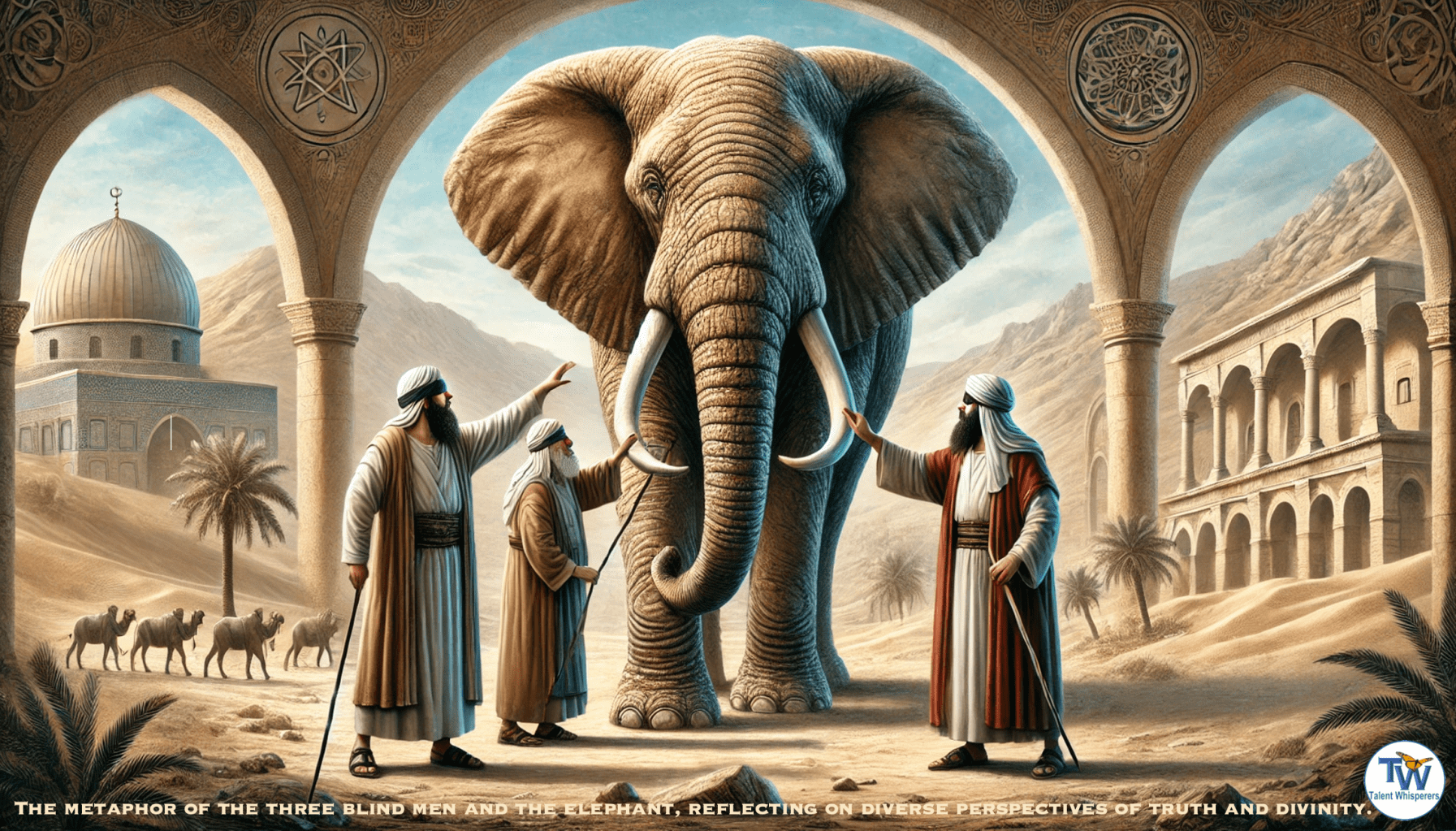
Is God an Elephant? In a recent discussion with a friend about “God” I mentioned the interpretative nature and potential for loss in translation. The fable of the three blind men and an elephant came up. In hindsight, it seemed very apt for our discussion. So, I did a little research and found the fable has been leveraged in this context before.
The Parable of the Three Blind Men and the Elephant and God
The parable has been used as a metaphor for how different belief systems attempt to describe God or the divine. This analogy is present in various cultural and religious traditions, including Hinduism, Jainism, Buddhism, and Sufism.
Hinduism
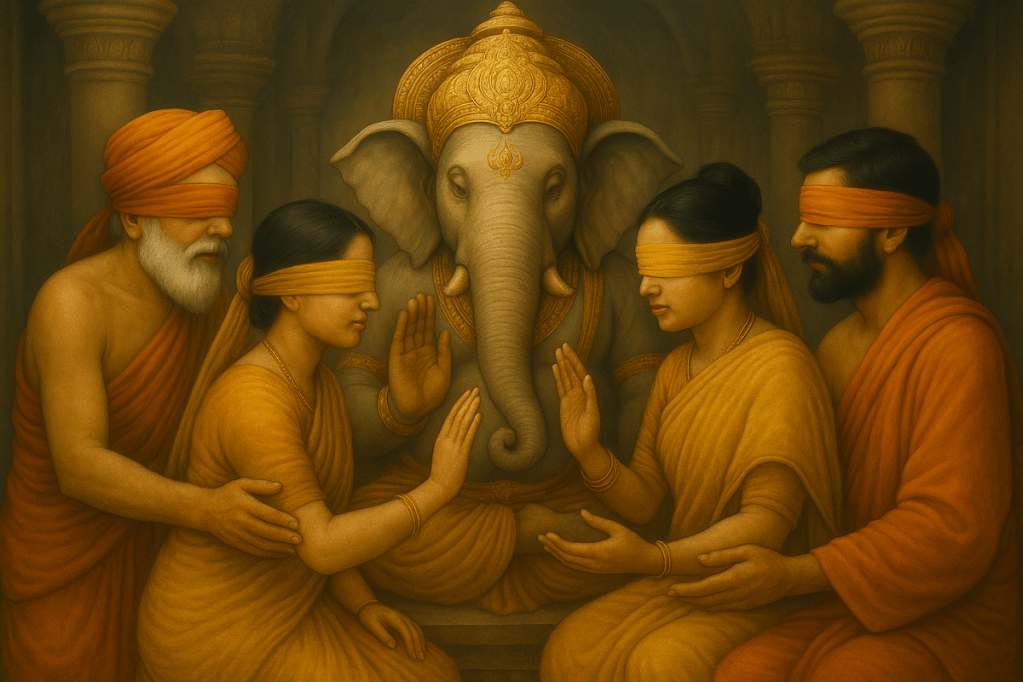
In Hinduism, the parable aligns with the idea that “Reality is one, though wise men speak of it variously.” This emphasizes that while different paths or perceptions might seem contradictory, they all aim to describe the same underlying truth.
The concept in Hinduism that “Reality is one, though wise men speak of it variously” comes from the Rigveda. This is one of the oldest sacred texts of Hinduism. This idea captures a central theme in Hindu philosophy: the notion that ultimate reality (often referred to as Brahman) is singular, universal, and unchanging, but human beings perceive and describe it in different ways depending on their perspectives and experiences.
Unity in Diversity of Thought:
- Brahman is the term used in Hinduism to describe the ultimate, transcendent reality that is the source of all existence. It is formless, infinite, and beyond comprehension. Different schools of thought within Hinduism, such as Advaita Vedanta, Vaishnavism, and Shaivism, each focus on different aspects of this same underlying reality. The diversity of paths (bhakti, jnana, karma, etc.) reflects the different ways people understand and relate to Brahman.
- This idea aligns with the Rigveda’s verse: “Ekam sat, vipra bahudha vadanti,” which translates as “Truth is one, though the sages call it by many names.” This highlights the Hindu belief that while people may use different names and descriptions (such as God, Brahman, or the universe), they are all attempting to describe the same singular truth that pervades everything.
Different Paths, One Destination:
- The metaphor of different paths leading to the same mountain peak is often used to explain this. In Hinduism, it is believed that while different people follow various spiritual practices or believe in different deities, they are ultimately all striving toward the same spiritual goal: union with or understanding of Brahman.
- This concept fosters a pluralistic view of religion in Hinduism. For example, people may worship deities like Vishnu, Shiva, or Devi, or they may follow the path of non-dualism (Advaita) that emphasizes the oneness of the self with Brahman. Yet, all these practices are seen as legitimate means to understand the ultimate truth.
Interpretations Across Philosophies:
- In Advaita Vedanta (a major philosophical school in Hinduism), it is believed that Brahman is the only true reality and everything else is an illusion (Maya). The wise perceive Brahman as the ultimate truth, while others perceive the world of duality. The differing perceptions arise from individuals’ level of spiritual insight.
- In Bhakti (devotional) traditions, personal devotion to a deity such as Krishna or Rama is emphasized. The variety of deities in Hinduism reflects the many forms through which people can connect with the divine, but all deities are seen as manifestations of the same Brahman.
Jainism
Jainism uses the parable to illustrate the concept of “anekāntavāda,” or many-sidedness. This highlights that truth can be perceived in multiple ways, depending on one’s viewpoint. Anekāntavāda encourages tolerance, humility, and respect for differing views, as all are considered incomplete without others’ insights. Jain philosophers use this principle to argue against absolutism, promoting a balanced, non-dogmatic approach to understanding truth.
Buddhism
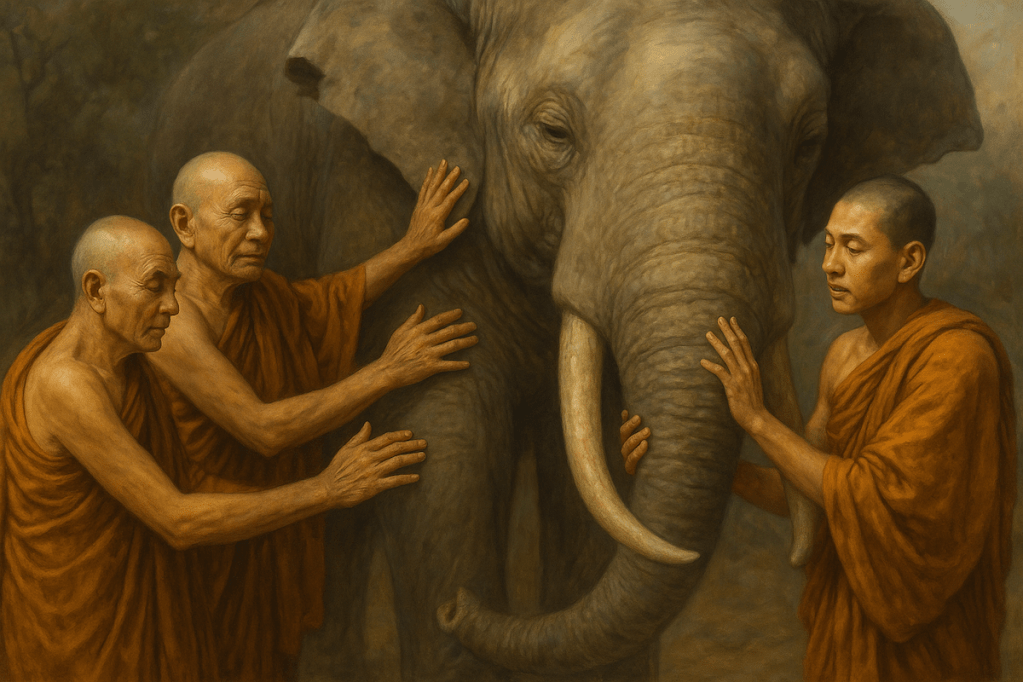
Buddhism also uses the story to illustrate sectarian quarrels. The Buddha pointing out that each person clings to their limited perspective without recognizing the full truth.
Key Concepts:
- Non-attachment to Views: In Buddhism, attachment to one’s ideas or beliefs is seen as a form of ignorance, which leads to suffering. By recognizing the limitations of individual perspectives, the Buddha encourages open-mindedness and the pursuit of a broader, more holistic understanding of reality.
- Dependent Origination (Pratītyasamutpāda): This concept explains that all things arise and exist in dependence on conditions. No single perspective can account for the full complexity of the interdependent nature of reality. It teaches that phenomena are not isolated, and seeing beyond one’s limited viewpoint can help grasp the interconnectedness of existence.
- Right View (Sammā-Diṭṭhi): As part of the Noble Eightfold Path, right view refers to understanding the nature of suffering, impermanence, and the absence of a fixed self. A correct understanding is not static but evolves as one deepens their practice and knowledge, moving away from dogmatic beliefs toward wisdom.
- Holistic View: By embracing multiple perspectives, one can move beyond the ego-driven need to be “right.” The Buddha promoted the idea that only through non-attachment to our limited perceptions can we approach a more profound understanding of the ultimate truth.
- Sectarian Quarrels: The Buddha often pointed out that disputes among followers of different sects or schools of thought arise from their failure to recognize that their perspective is only part of a greater whole. This teaching promotes humility and openness to learning from others.
The Taoist Take
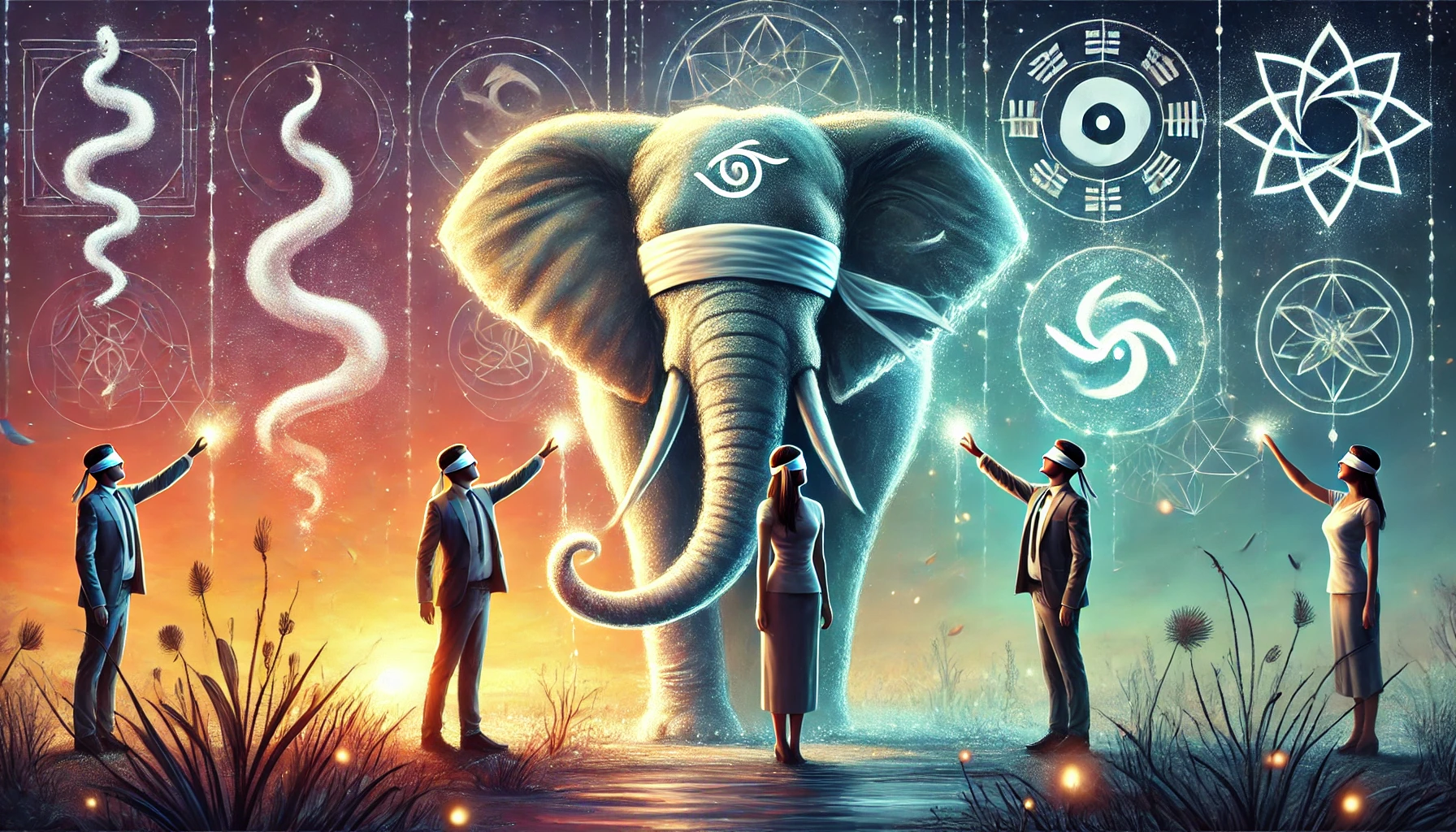
In Taoism, the Tao (the Way) signifies the underlying force that guides all existence, yet it cannot be fully explained or grasped. It represents the natural flow of the universe, constantly evolving and influencing everything.
This concept acknowledges that reality is complex and fluid. Each individual approaches the Tao in their own way, shaped by their unique life experiences. Because life is ever-changing, so too is each person’s understanding of the Tao.
Taoism teaches that no single path or belief system captures the full essence of the Tao. Each person’s perspective is seen as equally valid, as the Tao is boundless and can be experienced from countless viewpoints.
By embracing the Tao, one learns to flow with the rhythms of life rather than resist them. This fosters adaptability, acceptance, and harmony with the universe’s natural cycles, reinforcing the Tao’s inherent fluidity.
Islamic Views
In Islam, ijtihad allows for flexibility in interpreting religious texts through independent reasoning. It fosters adaptability in diverse cultural contexts. This encourages the coexistence of multiple interpretations within Islam, particularly in Sunni and Shia traditions.
Sufi mysticism emphasizes personal connection with the divine, highlighting that each individual’s spiritual journey is distinct and shaped by life experiences. Sufis view the path to God as deeply personal, driven by meditation, devotion, and direct experience, rather than strict legalism.
Islamic thought recognizes the value of diverse perspectives, particularly through ijtihad and Sufism, where both collective tradition and personal spirituality enrich religious understanding.
Sufi Traditions
Sufi traditions, particularly in the works of poets like Rumi, use the story to highlight the limitations of individual perception. It encourages a deeper understanding beyond mere appearances.
Rumi’s “The Elephant in the Dark” tells of people touching an elephant in a pitch-dark room. Each person feels a different part and, based on this, forms a unique, limited understanding of the elephant. Rumi uses this story to highlight the limitations of individual perceptions. Each person believes their understanding is correct, but all of them miss the full reality. This mirrors the human condition—where individuals grasp small pieces of truth, but fail to see the whole.
Rumi urges people to recognize the unity behind diverse experiences. He stresses that truth is one, but people view it through the narrow lens of their senses. This leads to confusion, argument, and misunderstanding. His solution? Spiritual insight—symbolized by a “candle” in the poem—can illuminate reality. When people gain spiritual understanding, they see the larger truth and differences disappear. For Rumi, this emphasizes the Sufi belief in transcending personal views to perceive divine unity.
Sikh Perspectives – God as an Elephant

Sikh Perspectives – God as an Elephant
In Sikhism, truth is understood as multifaceted, and the tradition acknowledges that people arrive at understanding from diverse life paths. This aligns with the broader Sikh principle of humility and openness toward others’ viewpoints, which are shaped by their unique backgrounds and experiences. It reflects the foundational Sikh virtues of humility, inclusivity, and equality, central to Guru Nanak’s teachings.
Sikh wisdom not only affirms multiple perspectives, it warns against the ego that can arise when one confuses perspective with possession of truth. The tradition repeatedly cautions against haumai, the subtle sense of “I know” or “I see clearly,” which can turn even sincere insight into rigidity. In this way, Sikh humility is not only openness to others’ views, but ongoing vigilance toward one’s own certainty.
Multiple Perspectives and the Oneness of Humanity
Guru Nanak emphasized that all beings are connected through Ik Onkar—the One Reality—while also recognizing the individuality of every soul’s journey. He taught that no single path, caste, gender, or belief system holds a monopoly on truth. The Guru Granth Sahib reinforces this with its inclusion of writings from saints across various faiths, social classes, and regions.
This approach invites us to listen to perspectives beyond our own—not just tolerate them but honor them as reflections of divine insight, seen through different eyes.
Miri Piri: Embodied Wisdom from Dual Realms
The concept of Miri Piri—unifying the spiritual and the temporal—encourages Sikhs to engage both with inner reflection and worldly responsibility. It symbolizes that different modes of seeing (devotional, political, experiential, and intellectual) are not at odds, but form a more complete understanding when held together.
For a woman practicing from within the Sikh tradition, this can mean navigating layers of identity—spiritual disciple, civic leader, family nurturer, and voice for justice—each offering its own valuable lens on the metaphorical “elephant.” Sikhism affirms the equal capability and authority of women to perceive and serve the divine, reminding us that gender-diverse perspectives deepen collective understanding.
Self-Reflection and Shared Truth
Sikh practice is grounded in naam simran (remembrance), seva (service), and sangat (community), all of which invite individuals to question their assumptions and learn from others. Truth is not just revealed through solitary insight, but also co-created through dialogue and shared experience.
This resonates with the Jain principle of anekāntavāda—that truth has many sides. Sikhism embraces this pluralism not as a compromise, but as a profound truth: no one touches the whole elephant alone.
Sikhism thus invites not only pluralism of views, but humility of stance, recognizing that no one touches the whole elephant alone, and that ego often hides closest to conviction.
See Also
- Anekāntavāda in Jainism – Plurality of Views
- SikhNet on Diversity and Perspective
- Miri Piri – The Sword and the Spirit (Sikh Foundation)
- Women in Sikhism: Equal in Spirit and Leadership
- Guru Granth Sahib and Interfaith Teachings
Native American Views
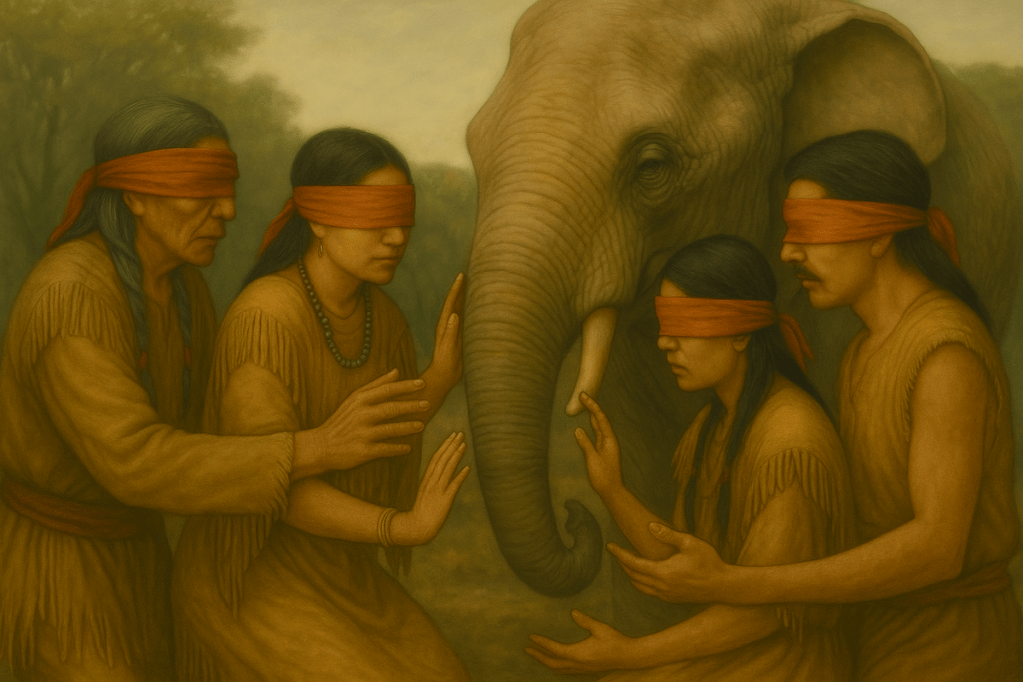
Many Native American spiritual traditions emphasize the deep connection between individuals and the natural world, shaped by their unique experiences. These connections form the foundation for spiritual practices that respect nature as a living, sacred entity.
In these traditions, diverse perspectives are seen as enriching the collective wisdom. Communal decision-making reflects this, as each person’s experience contributes to understanding how to live in harmony with the environment.
The belief that every perspective holds value reinforces the importance of mutual respect and listening. This respect extends not only to human voices but also to nature itself, seen as a teacher and guide.
The focus on balance with nature highlights the importance of harmony between personal experiences and the larger world. This understanding shapes how communities interact with nature and each other, acknowledging the wisdom that emerges from diversity.
The Lakota people deeply honor the relationship between individuals and nature, particularly through the concept of Mitákuye Oyás’iŋ (“All My Relations”). This philosophy emphasizes that all beings are interconnected, and each person’s experience with the natural world shapes their understanding of life.
The Iroquois Confederacy (Haudenosaunee) is known for its Great Law of Peace, which encourages respect for diverse perspectives in communal decision-making. The Iroquois believe in the importance of considering the wisdom of all, including the natural world, when making decisions.
The Hopi people view themselves as stewards of the earth, with a focus on maintaining balance and harmony with nature. Each individual’s connection to the land is seen as essential to the wellbeing of the entire community.
The Diné (Navajo) emphasize Hózhó, or harmony and beauty, which reflects living in balance with nature. Each person’s relationship with the environment is considered vital to spiritual and communal health.
Modern Interpretations
In modern interpretations, some have argued that the parable suggests that all religions are attempting to describe the same divine reality in different ways. However, critics of this interpretation, like Christian theologians, argue that the story itself implies a contradiction. If one claims all perspectives are only partially true, that person must assume a position of seeing the full truth. This too goes against the parable’s message of humility and limited perception.
The story is widely accepted as a philosophical tool to promote understanding and tolerance among different faiths. This highlights the idea that while our experiences and descriptions may vary, they might all be pointing to the same ultimate reality. Yet even beyond humility, the parable reminds us that clarity depends not only on gathering more perspectives, but also on stepping back far enough to let the whole come into view.
Standing Too Close to the Elephant

We don’t have to be blind to miss the elephant. Sometimes we stand so close to one true feature that it fills our vision and distorts the whole. In matters of faith, that “feature” is often a single verse, line, or teaching lifted from its living context of story, tradition, and practice.
This differs from the classic parable. The blind-men story warns about fragmented parts. “Standing too close” warns about distorted scale. You can fixate on the same part everyone agrees exists — yet, by pressing your face against it, mistake a brushstroke for the painting.
Why does closeness bend meaning? Because sacred words travel through people: from voice to memory, to manuscript, to canon, to translation, to us. Each step may only result in a slightly nuanced change, but without the overall context can lead to misinterpretation. Read too near, poetry hardens into statute; a local caution inflates into a universal rule; a parable designed to open the heart becomes a proof-text to close a debate.
A better way may be to read in altitudes:
- Verse-level (grain): What problem is this line addressing, for whom, and in what moment?
- Book-level (chapter/genre): How does the surrounding narrative, poem, law, or letter shape its force?
- Tradition-level (elephant): How does this reading serve the telos — the through-line virtues this faith seeks to cultivate (compassion, justice, humility, liberation, union, stewardship)?
Practical guardrails:
- Name the genre before the claim. Parable, wisdom, lament, law, prophecy — form carries meaning.
- Pair hard lines with the wider arc. Lay a “severe” verse beside recurring themes of mercy and humility; let the canon interpret the canon.
- Listen across translations. Divergences reveal what’s stable (idea) and what’s fragile (wording).
- Test by telos. If a close reading licenses a posture the tradition softens at scale, you’re likely too near. Step back until the elephant appears.
The point isn’t to dilute conviction; it’s to right-size it. We honor the text not by pressing closer until it blots out the world, but by giving it the space of its true proportion — where part and whole can speak to each other without distortion.
The Elephant and Three Blind Men without the God Context

The parable that illustrates how different perspectives can lead to different interpretations of the same thing. In the tale, three blind men encounter an elephant, and each touches a different part of its body.
One man touches the trunk and thinks the elephant is like a snake. Another feels its leg and believes it resembles a tree trunk. The third man touches its side and concludes that the elephant is like a wall. Each man describes the elephant based on his limited experience. They argue because they each believe they understand the true nature of the elephant.
The story highlights the idea that people’s perceptions can be limited by their experiences. It suggests that no one person has the full picture. It suggests the importance of considering multiple perspectives to gain a more complete understanding of reality. This parable has been used in various cultures and teachings to illustrate the limitations of subjective experience and the value of collaborative insight.
The Elephant in the Room

Recognizing and tolerating different perspectives in others is but one lesson of the parable. The other is to remain open and question the limitations of our own perceptions and convictions.
Understanding why others may hold other perspectives and convictions is a first step. Recognizing that our perceptions and convictions may be limited is another step. Seeing the value in others’ perceptions and convictions is yet a further step. Being at peace with and recognizing the beauty and value of a diversity of perspectives that opens us to a world of possibilities is a great plan to land. It’s also a great place to start to grow and learn.
The Four Noble Truths
There are similarities to The Four Noble Truths of Buddhism which teach that suffering (dukkha) is inherent in life, but blaming others perpetuates delusion and attachment. The Noble Eightfold Path, particularly Right Understanding and Right Intention, encourages self-reflection rather than blame.
- Blaming others is often a sign of ignorance and attachment, a refusal to recognize the role of one’s own mind in generating suffering.
- Blaming oneself suggests a developing awareness but still carries attachment to the ego and self-centeredness.
- Blaming no one indicates the realization that suffering arises from attachment and aversion, and through non-attachment, one can transcend suffering.
A well-known Buddhist saying goes: “When the mind is free of blame and hatred, wisdom shines.”
Taoism
In Taoism, the concept of wu wei (non-action or effortless action) aligns with not blaming others or oneself. This can also hold for accepting others’ perspectives and convictions. The Taoist path encourages going with the natural flow of the universe, without resistance or judgment.
- Blaming others suggests one is resisting the natural flow and clinging to ego or external expectations.
- Blaming oneself indicates an internal struggle but still involves unnecessary attachment to outcomes.
- Blaming no one reflects harmony with the Tao, meaning one is fully aligned with the natural order, understanding that events occur as they are meant to without personal attribution of fault.
In the Tao Te Ching, Laozi says: “When there is no blame, who is there to accuse?” This speaks to the Taoist idea of embracing life as it is, without assigning fault.
See Also
- Everything a Mirror – an exploration that everything we see or perceive is largely a reflection of ourselves as shaped by our experiences.
- Parallel Universes – The notion that our unique perspectives essentially create distinct experiences. We each live in a parallel universe with shared experiences but unique perceptions.
Perennial Philosophy: A Shared Thread Beneath All Belief
The fable of the blind men and the elephant invites not just pluralism — but humility. At the heart of this story is a truth echoed across many spiritual traditions: that ultimate reality exists, but our perceptions of it are always partial, colored by experience, language, and longing.
This insight is central to what scholars call the Perennial Philosophy — the idea that beneath the surface differences of religion, culture, and doctrine lies a common current of truth:
- That being is unified.
- That human perception is limited.
- That transformation comes not by proving others wrong, but by embracing the deeper whole we can only glimpse.
In Hinduism, it is Brahman — described differently by different sages.
In Jainism, it is anekāntavāda — the belief that all perspectives hold partial truth.
In Buddhism, it is Right View — the evolving clarity that transcends dogma.
In Taoism, it is the Way — real, but beyond naming.
In Sufism, it is the candle in the dark room — a light of unity behind our shadows of difference.
In Sikhism, it is Ik Onkar — One Reality, revealed through diverse voices.
And in Indigenous wisdom, it is the sacred circle — truth emerging through story, silence, and community.
To recognize this is not to dilute truth. It is to deepen it — by holding it gently, curiously, and together.
See Also
Perennial Philosophy – Wikipedia
A clear, well-sourced overview of philosophia perennis, the belief that all major wisdom traditions point to a shared metaphysical truth. Includes historical roots, contributions by Aldous Huxley, and cross-cultural expressions of this idea.
 Human Transformation