
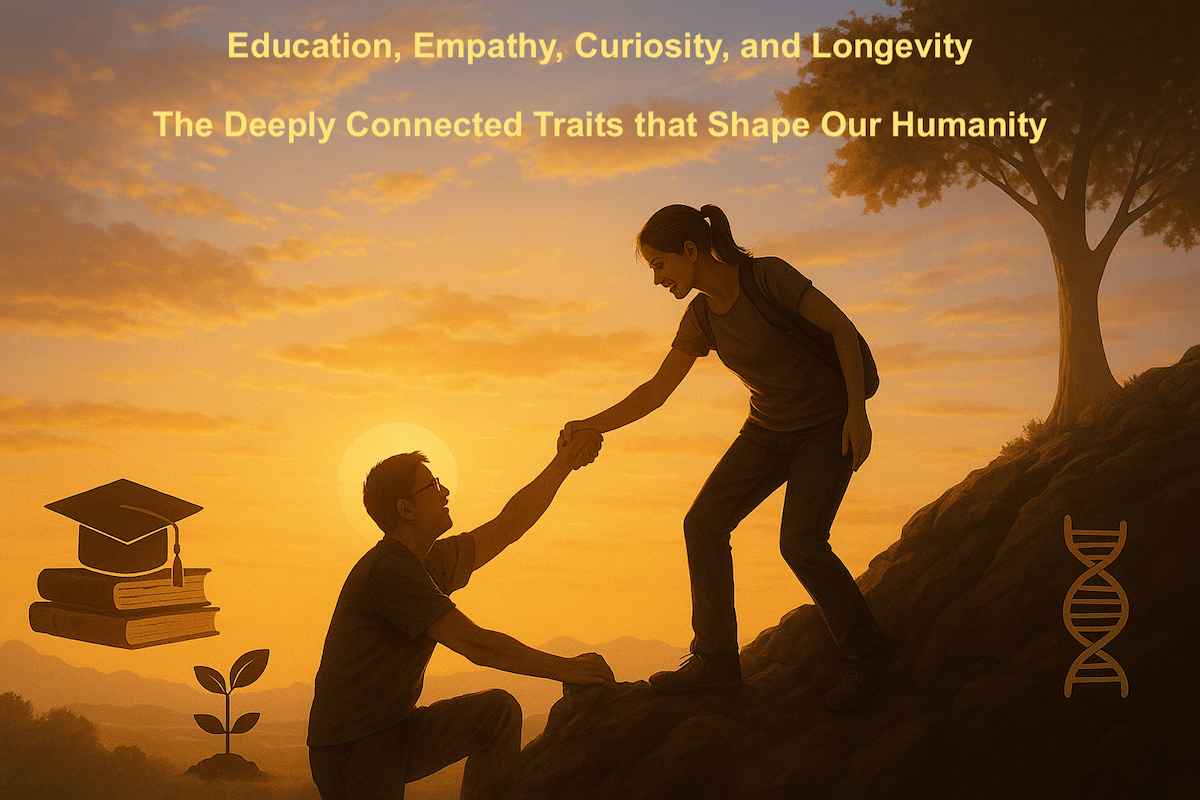
The Deeply Connected Traits that Shape Our Humanity
What if the desire to learn and the desire to care for others are more than just admirable qualities? Could they be hardwired traits tied directly to our survival, fulfillment, and legacy? This exploration offers a compelling hypothesis: that education, empathy, curiosity, and longevity are not isolated traits or goals, but deeply interwoven dimensions of what it means to be human.
1. Curiosity as a Core Human Trait
Curiosity is foundational. It’s our drive to explore, learn, solve problems, and adapt. Research in neuroscience shows that curiosity activates the brain’s reward system in much the same way as food or social connection. This “wanting to know” impulse supports survival by enhancing our capacity to acquire knowledge, assess risks, and innovate.
- Supporting Insight: A 2014 study in Neuron (Gruber et al.) found that curiosity not only improves learning but also activates the dopaminergic system, enhancing memory retention.
- Evolutionary View: Early humans who explored and adapted survived environmental threats more effectively—curiosity wasn’t a luxury, it was a survival advantage.
2. Empathy as Evolutionary Glue
Empathy—the ability to recognize and share the feelings of others—has also been essential to human survival. As a social species, we’ve thrived through cooperation and care. Empathy builds trust, enables shared child-rearing, and strengthens community resilience.
- Scientific Backing: Functional MRI studies (e.g., Decety & Jackson, 2004) demonstrate that helping others activates reward centers in the brain, suggesting an innate neurobiological drive to connect.
- Sociobiological Theory: The work of E.O. Wilson and others in sociobiology suggests that traits like empathy have evolved precisely because they enhance group cohesion, and by extension, group survival.
3. Education as the Bridge
Education channels curiosity and strengthens empathy. It provides the structure through which we develop intellectual and emotional tools to not only understand the world but also to respond to it more effectively.
- Correlational Evidence: Studies show that higher levels of education correlate strongly with longer life expectancy, better health outcomes, and higher levels of civic engagement.
- Empathy Link: Educational exposure—especially to literature, social science, and diverse worldviews—has been shown to increase perspective-taking and emotional intelligence.
- UNESCO & WHO Reports: Education is consistently cited as the most impactful lever for improving societal well-being, public health, and inter-generational outcomes.
4. Longevity as a Collective Trait
While longevity is often framed individually, humans have historically cared about the survival and continuity of their community, not just their own lifespan. From legacy practices to clan continuity, we are wired to preserve what we value across time.
- Anthropological Insight: Cultural traditions around storytelling, apprenticeship, and ancestor veneration reflect a drive to pass on knowledge and values.
- Public Health Data: Higher education and social cohesion have measurable effects on life expectancy—not just for individuals, but across communities.
5. Legacy as the Extension of Life
When we shift the definition of “life” from merely physical existence to a broader sense of identity, influence, and presence, it becomes clear how empathy, curiosity, and education combine to extend us.
- Narrative Continuity: Who we are is shaped by those who taught, guided, or cared for us—and in turn, we shape others. This is a form of distributed immortality.
- Psychological Resonance: Viktor Frankl, in Man’s Search for Meaning, noted that purpose often stems from contributing to others and living in alignment with core values—values frequently learned through education.
A Unified Hypothesis
Education nurtures curiosity. Education also enhances empathy. These two traits increase not only our individual survival chances (health, longevity) but our capacity to care for others and contribute meaningfully. In doing so, we extend ourselves—our values, our ways of being—into the lives of others. Education is not simply about knowledge acquisition; it’s the activation of our most human drives: to grow, to connect, and to leave the world better than we found it.
Ultimately, the deeper value in pursuing curiosity, education, and empathy is not only to extend life, but to make life more meaningful – for ourselves and for those we touch.
See Also
- The Relationship Between Education and Mortality – NCBI
- UNESCO: Education Transforms Lives
- The Empathy Instinct – UC Berkeley
- Curiosity and the Brain – Scientific American
- Education and Health: The Overlooked Issue in Health Reform – Health Affairs
- Man’s Search for Meaning by Viktor Frankl – Goodreads
 Human Transformation