
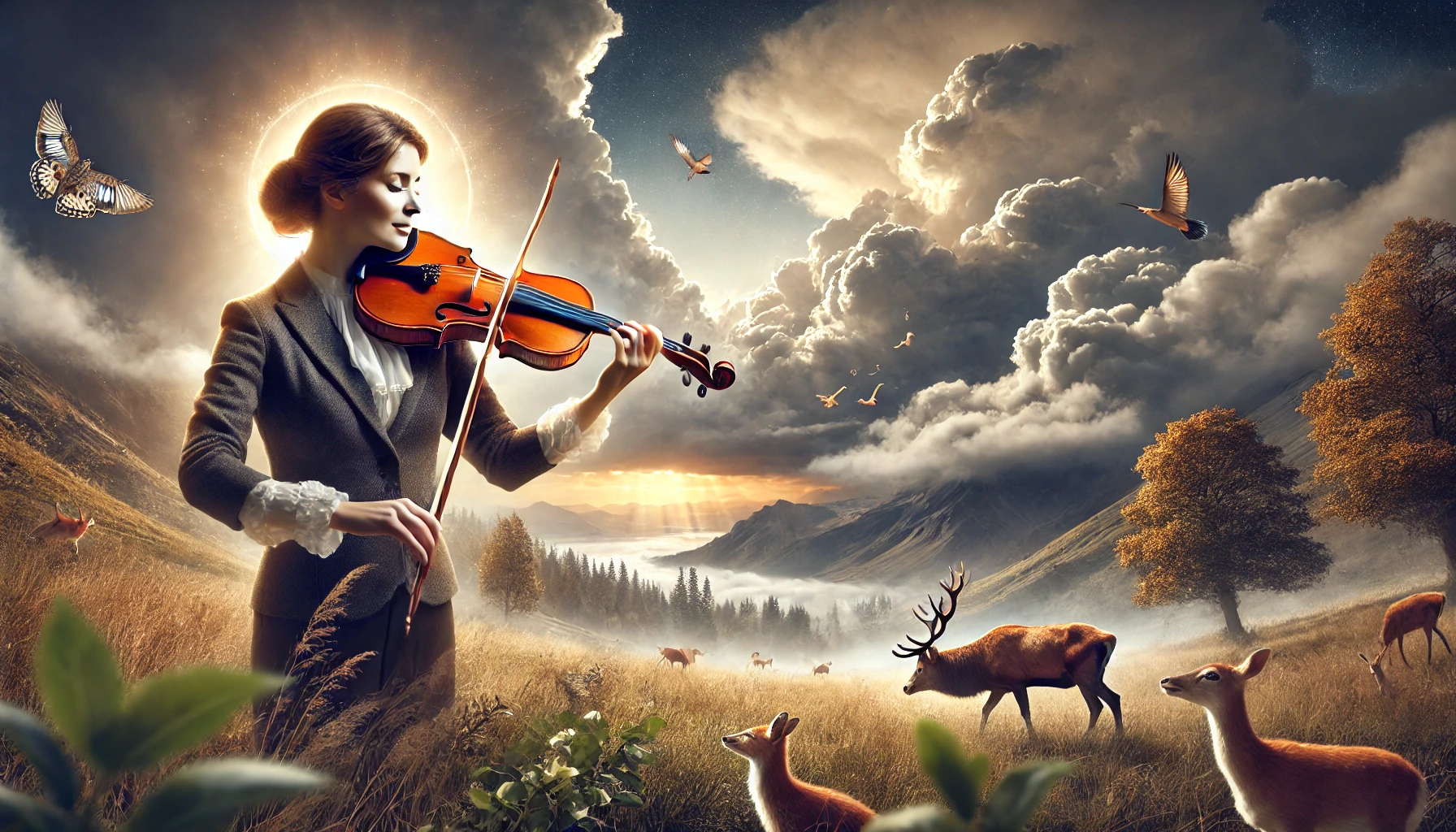
The Musician, the Song, and the Divine Violinist: A Christian Perspective
Christian belief provides a profound foundation for understanding the interplay between God and humanity through the metaphors of The Musician and the Song and The Stradivarius Violin and the Divine Violinist. These metaphors illustrate the relationship between human beings and God, exploring themes of divine image, mystical union, and co-creation with the Creator.
The Image of God and Mystical Union
Imago Dei: The Divine Imprint
Christian theology teaches that humans are made in the image of God (Imago Dei). This means each person carries a divine imprint. We are not merely instruments played by God but endowed with divine qualities—consciousness, creativity, and moral awareness. These qualities enable us to actively participate in the music of existence.
Much like a Stradivarius violin, every human being is crafted with care and intention. The violin, though an instrument, carries a resonance that allows for breathtaking beauty when played by a skilled musician. However, the violin is not just an inanimate object. It collaborates in the music, responding to the artist’s touch and resonating with the strings. Similarly, humans, though distinct from God, possess an inner divine resonance. When aligned with God’s will, they express goodness and love.
Union with God: The Song and the Melody
Christ’s teaching on unity with God suggests that humans can participate in divine life: “I am the vine; you are the branches” (John 15:5). In this analogy, the source of life and sustenance comes from divine connection. Without the vine, the branches wither. Without divine rhythm, the melody falls apart. The closer we attune ourselves to God, the more harmoniously we live.
Christian mysticism, as taught by figures like Meister Eckhart and Julian of Norwich, speaks of union with God. This teaching suggests that the boundary between self and the divine becomes blurred. It resonates with the metaphor of the Musician and the Song—humans are not separate from the divine melody but are intimately woven into it. A violin produces its most beautiful sound when finely tuned and played with precision. Likewise, the human soul flourishes when aligned with divine truth and love.
The Violinist, the Player, and the Divine Guide
The Expanded Metaphor: More Than an Instrument
The violin is more than just a tool. It actively participates in creating music. It resonates with the song, much as a person resonates with the divine when living in alignment with it. The violinist is not separate from the violin but engages with it, uniting the physical embodiment of the individual with the music itself.
In this expanded view, the human being is not only the violin but also the artist playing it. The divine serves as the guiding force, providing inspiration and direction. This ensures the song remains harmonious and in tune. This metaphor highlights a deeper truth: the individual is not a passive instrument but an active, guided participant in co-creation.
Every human being holds a divine essence that both guides and responds to divine harmony. When attuned to this inner divinity, they experience joy, serenity, peace, and inspiration. A musician finds fulfillment in creating a beautiful melody. In the same way, individuals are enriched when they co-create in harmony with God. This experience is not just for God’s glory but also for personal fulfillment. Divine co-creation is both a duty and a source of joy.
Theosis: Becoming One with the Divine Harmony
In Eastern Orthodox Christianity, the concept of Theosis describes the process by which humans become divinized through spiritual transformation. This does not mean humans become God in essence. Rather, they are drawn into a deeper communion with God, participating in His divine nature.
This aligns with the metaphor of the Stradivarius and the Divine Violinist. When properly attuned, the human soul resonates with the divine hand that plays it. However, it also suggests that the individual has an active role in shaping the music of their own life. Humans are both violin and violinist, attuned to divine wisdom.
Co-Laboring with God: The Role of Human Participation
Humans as Co-Creators in the Divine Symphony
Christian theology does not position humans as passive instruments but as co-laborers with God. “For we are co-workers in God’s service” (1 Corinthians 3:9). This suggests that humans do not merely receive divine influence. Instead, they participate in shaping the music of creation.
This perspective aligns with the metaphor of The Musician and the Song. Humanity is both the listener and the singer, both the instrument and part of the melody. God provides the foundational rhythm. Humans are called to add their voices, choices, and creativity to the unfolding song of existence.
Stewardship: Shaping the World in Harmony with God
The concept of stewardship in Christianity further reinforces this idea. In Genesis 2:15, humanity is entrusted with caring for creation. This implies responsibility, agency, and co-creation. Just as a violinist carefully maintains their instrument, humans must cultivate their gifts and surroundings. This ensures they remain in harmony with divine intention.
A violin, left unmaintained, falls out of tune. A human life, when untended, drifts from righteousness. Christian practice—prayer, worship, and moral action—serves as the means of re-tuning oneself to divine harmony.
Faith Accompanied by Action: Playing in Divine Rhythm
Christian theology teaches that faith must be accompanied by action. While God provides the melody, humans must play in harmony through moral choices and service. James 2:26 states, “Faith without works is dead.”
In the metaphor of The Musician and the Song, God sets the divine rhythm. However, humans must actively participate in singing, playing, and living in tune with that rhythm.
Conclusion: The Divine Symphony of Life
The Christian understanding of humanity’s relationship with God reflects both dependence and partnership, harmony and participation, individuality and divine union. The metaphors of The Musician and the Song and The Stradivarius Violin and the Divine Violinist capture this beautifully:
- God is both the violinist and the composer, setting the rhythm and guiding the melody.
- Human beings are both the violins and the artists, shaping and responding to the music.
- We are also co-creators, singing and playing alongside the divine, shaping the music of creation.
- Through faith, action, and alignment with God’s will, we participate in a symphony greater than ourselves. This brings not only purpose but also deep joy and fulfillment.

See Also:
- Mere Christianity – C.S. Lewis
- The Imitation of Christ – Thomas à Kempis
- The Practice of the Presence of God – Brother Lawrence
- The Interior Castle – St. Teresa of Avila
- Orthodoxy – G.K. Chesterton
- A Journey of Human Transformation
 Human Transformation