
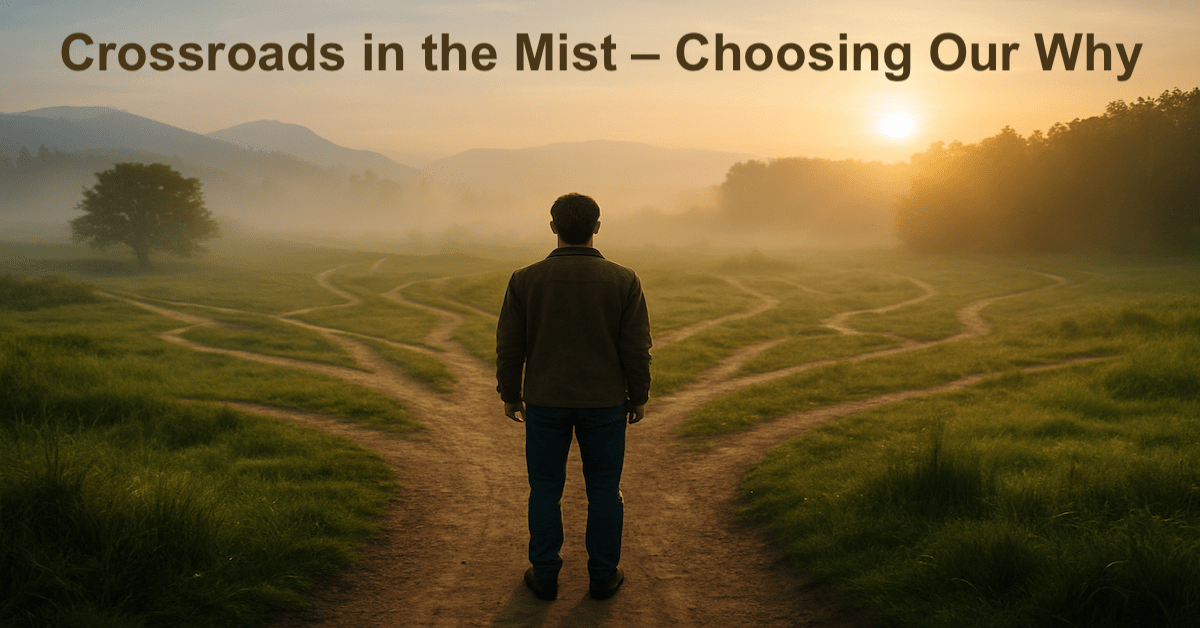
Why do we make the choices we do—from the coffee we order to the life partner we choose? Most of us rarely stop to ask: why this choice, and not another? Beneath every purchase, relationship, risk, or retreat lies a deeper motivation, often invisible even to ourselves.
These drivers aren’t random. They come from a small set of universal “whys” that quietly shape how we spend our time, energy, and money. Once we can see them, we can predict them. And once we can predict them, we can shape them.
In the pages ahead, we’ll explore how to spot the hidden “why” behind our decisions, anticipate the actions and hesitations of others, and make choices that align with our deepest goals—so we act with more clarity and intent.
Simon Sinek’s “Start With Why”
Before we dive into the full spectrum of our deeper motivations, it’s worth acknowledging one of the most influential voices to bring “Why” into everyday conversation. Simon Sinek’s work has helped millions of people and organizations think more clearly about their purpose — a perspective that resonates with part of what we’ll explore here, even as we broaden the lens to include all the reasons we choose, act, and care.
When most people think of “Why,” they think of Simon Sinek’s now-classic TED Talk How great leaders inspire action and book, Start With Why. In it, Sinek offers a simple but powerful model for leadership and influence — the Golden Circle:
- Why – The core belief or purpose that inspires you or your organization.
- How – The process or values that bring that purpose to life.
- What – The tangible products, services, or actions that result.
Sinek’s insight is that most people and organizations work from the outside in — starting with what they do, maybe explaining how they do it, and often neglecting why. The most inspiring leaders and brands reverse this, starting with why and letting that purpose shape every decision.
Where our exploration goes further
Sinek’s model is a compelling call to clarity and alignment, but it focuses mainly on purpose in a professional or organizational context. Our journey here looks at “Why” more broadly — as the underlying driver of every human choice: from the brands we buy to the relationships we build, from the risks we take to the mornings we choose to get up and try again.
Where Sinek helps us frame the purpose that can inspire action, our six-whys framework helps us see the variety of deeper motives that show up across our lives — some conscious, some instinctive, all deeply human. Both perspectives are useful: Sinek’s to anchor our vision, and this broader framing to recognize and work with the full spectrum of what moves us.
The Six Core Whys of Human Action
When we strip away surface explanations, we tend to find the same recurring patterns. We act:
To Gain, To Avoid Harm, To Save Resources, To Protect Identity, To Grow, and/or To Belong.
These six aren’t slogans; they’re lenses. Each reveals a different contour of the same decision.
As we read, we can ask: Which of these is speaking the loudest in me right now? Which one am I under-listening to? The answers often explain not only what we choose, but why some choices still don’t feel right after we make them.
1. To Gain
We reach for what expands our options—usefulness, pleasure, beauty, knowledge. The pull is possibility: more room to move, more ways to shape our world. Signal to watch: we justify “gain” even when the benefit is thin; clarity comes from naming the real gain we seek.
- Seeking benefits, opportunities, pleasure, beauty, knowledge, or experiences that feel rewarding or expand capability.
- Examples: Getting a promotion, tasting a new cuisine, upgrading a tool.
2. To Avoid or Reduce Harm
We step back to protect health, reputation, relationships, and stability. This isn’t just fear; it’s wisdom about risks that matter. Signal to watch: when every path looks dangerous, we’re probably missing a safer, smaller next step.
- Steering clear of physical danger, emotional pain, financial loss, reputational damage, or uncertainty.
- Examples: Buying insurance, avoiding a bad investment, leaving a toxic workplace.
3. To Save Resources
We guard time, money, energy, attention. Conservation creates capacity for what matters most. Signal to watch: saving by default can become costly—ask what we’re saving for.
- Conserving time, energy, effort, attention, or money for other priorities — increasing efficiency and reducing friction.
- Examples: Choosing a faster commute, using automation tools, shopping in bulk.
4. To Protect or Elevate Identity
We choose what matches who we believe we are (or hope to be seen as). Identity can anchor courage—or trap us. Signal to watch: when “how I’ll look” outruns “who I am becoming.”
- Preserving self-image, affirming values, signaling status, or belonging to a desired group.
- Examples: Wearing a certain brand, donating to a cause, choosing language that matches a peer group.
5. To Pursue Growth or Mastery
We seek challenge and learning that stretch our abilities. Growth builds resilience and opens futures we couldn’t see before. Signal to watch: growth without rest becomes grind; mastery includes recovery.
- Seeking challenge, skill development, self-actualization, and long-term improvement — not just short-term gains.
- Examples: Taking a difficult course, training for a marathon, starting a creative project.
6. To Connect or Belong
We move toward people, places, and purposes that feel like home. Belonging heals isolation and multiplies strength. Signal to watch: fitting in is not the same as belonging; one shrinks us, the other enlarges us.
- Building or strengthening relationships, trust, and shared purpose — reducing isolation and increasing shared identity.
- Examples: Joining a club, attending a conference, supporting a friend’s project.
5 Whys on each Why
Naming a motivation is helpful; tracing it down is transformative. The 5 Whys technique asks, “Why does that matter?” five times, peeling back layers until we reach bedrock.
When we follow each core why down this trail, we keep landing on two roots: survival (continuity, safety, stability) and meaning (a life worth sustaining). Seeing this convergence changes how we coach ourselves and others: we stop arguing about surface choices and start serving the real need underneath.
1. To Gain
- Why gain something? Because acquiring benefits improves our situation or gives us more options.
- Why is improving our situation important? It increases our chances of success, comfort, and influence.
- Why do we want more success, comfort, and influence? They provide security, status, and opportunities to shape our environment.
- Why do we want security, status, and control over our environment? So we can thrive without constant threat or scarcity.
- Why do we want to thrive without threat or scarcity? To ensure survival and create the conditions for self-expression and fulfillment.
Root Why: Survival with surplus, enabling self-expression.
2. To Avoid or Reduce Harm
- Why avoid harm? Because harm can threaten our health, resources, or relationships.
- Why does protecting those matter? They are essential to living a stable, functioning life.
- Why is stability important? Stability allows us to plan, build, and invest in the future.
- Why do we want to plan and invest in the future? To improve our life and ensure continuity for ourselves and those we care about.
- Why do we care about continuity? It protects life itself and preserves meaning in our existence.
Root Why: Survival and continuity of life and meaning.
3. To Save Resources
- Why save resources? So we can use them where they matter most.
- Why does resource allocation matter? It maximizes our impact and minimizes waste.
- Why is maximizing impact important? It helps us reach goals more effectively and quickly.
- Why reach goals effectively and quickly? It frees capacity for new opportunities and reduces risk.
- Why is freeing capacity and reducing risk important? It supports long-term survival and growth.
Root Why: Survival through efficient resource management.
4. To Protect or Elevate Identity
- Why protect or elevate identity? Our identity shapes how we see ourselves and how others treat us.
- Why does that matter? Social perception affects opportunities, trust, and belonging.
- Why are opportunities, trust, and belonging important? They increase our chances of survival, influence, and emotional well-being.
- Why is emotional well-being important? It supports mental and physical health, enabling us to thrive.
- Why thrive socially and emotionally? Humans are social animals — our survival historically depended on group acceptance.
Root Why: Survival through social cohesion and self-consistency.
5. To Pursue Growth or Mastery
- Why pursue growth or mastery? It allows us to reach our potential and expand what’s possible.
- Why expand what’s possible? Greater capability increases resilience and opportunity.
- Why is resilience important? It allows us to withstand challenges and adapt to change.
- Why adapt to change? Adaptability increases survival odds in uncertain environments.
- Why survive in uncertainty? To preserve life, meaning, and potential for future generations.
Root Why: Survival through adaptability and expanded potential.
6. To Connect or Belong
- Why connect or belong? Social bonds provide support, protection, and shared resources.
- Why do support and shared resources matter? They increase survival odds and emotional well-being.
- Why is emotional well-being important? It maintains motivation, reduces stress, and promotes cooperation.
- Why is cooperation important? Groups outperform individuals in resilience, problem-solving, and defense.
- Why do we want group resilience and problem-solving? It ensures survival and enhances the quality of life.
Root Why: Survival through cooperation and shared meaning.
Big Pattern
Different paths, same destination. Whether we chase opportunity or avoid danger, conserve resources or claim identity, stretch to grow or reach to belong—we’re orienting around survival and meaning. Survival asks, Can we continue? Meaning asks, Is it worth continuing?
When survival is threatened, we optimize for safety. When it’s secure, we hunger for significance. Most seasons, we need a little of both. The art is knowing which root is calling now—and choosing accordingly.
When you drill down, all six whys converge on two intertwined human imperatives:
- Survival — physical, emotional, and social.
- Meaning — the sense that survival is worth sustaining.
The difference between them is the pathway they emphasize: gain, protection, conservation, identity, mastery, or connection.
Daniel Pink’s Drive: The Surprising Truth About What Motivates Us
Our six whys don’t stand alone; they resonate with other maps of human motivation. Daniel Pink’s Drive highlights autonomy, mastery, and purpose as the engines of lasting, intrinsic motivation.
Seen through our lens, autonomy draws strength from gain, identity, and resource stewardship; mastery aligns directly with growth; purpose rises from belonging and values. This crosswalk doesn’t replace either model—it helps us decide which lever to pull when motivation falters.
When we map the Six Core Whys onto other models of motivation, patterns — and gaps — emerge. Daniel Pink’s ‘Drive’ shows how our deepest motivations can be harnessed for lasting engagement. Daniel Pink’s Drive focuses on what he calls the three elements of intrinsic motivation:
- Autonomy – the urge to direct our own lives.
- Mastery – the desire to get better at something that matters.
- Purpose – the yearning to do what we do in service of something larger than ourselves.
He frames these as the deeper, more sustainable drivers in contrast to traditional extrinsic motivators (the “carrot and stick” approach).
Correlation to the Six Core Whys
If we map our Six Core Whys (and their deep roots) to Pink’s model, we get this:
| Pink’s Motivation Element | Relevant Core Why(s) | Overlap Notes |
|---|---|---|
| Autonomy | – To Gain (in the sense of gaining freedom or options) – To Protect or Elevate Identity (self-determination) – To Save Resources (efficiency frees control over time/energy) | Autonomy is partly about control over choices, which we frame as “gaining” options, protecting one’s identity, and freeing resources for self-directed goals. |
| Mastery | – To Pursue Growth or Mastery – To Gain (skills/resources toward mastery) | This is the cleanest alignment — our Growth/Mastery why directly matches Pink’s, and “gain” covers the tools and learning resources needed. |
| Purpose | – To Connect or Belong – To Protect or Elevate Identity (values alignment) – To Avoid or Reduce Harm (protecting what matters to a community or cause) | Purpose links strongly to belonging and identity; Pink frames it as serving something beyond self-interest, which also connects to our “Meaning” root. |
Where Pink’s framing is narrower
- Pink emphasizes intrinsic motivation — he’s largely talking about what keeps us engaged once basic needs are met.
- Our Six Core Whys are broader — they cover both intrinsic and extrinsic drivers, including survival-related motives (avoiding harm, saving resources) that Pink doesn’t emphasize because they’re more about baseline security than higher-level motivation.
Where Pink’s framing adds depth
- Pink puts autonomy on equal footing with mastery and purpose — in our model, autonomy is distributed across “Gain,” “Save Resources,” and “Protect Identity,” but we don’t elevate it as a standalone driver.
- He treats purpose as a unifying driver for meaning — in our tree, “Meaning” is a root, but Pink’s framing could help in making that root more actionable in motivational design.
Merged Insight
If we overlay Pink’s work on our Motivation Tree, the mapping looks like this:
- Autonomy → branches out of “Gain,” “Save Resources,” “Protect Identity.”
- Mastery → anchored almost entirely in “Pursue Growth or Mastery” but fed by “Gain.”
- Purpose → emerges most clearly from “Connect or Belong” and “Protect Identity,” and ties directly to the “Meaning” root.
This suggests a two-layer motivation map:
- Foundational Six Core Whys — covering survival and meaning across intrinsic/extrinsic.
- Intrinsic Driver Overlay (Pink) — showing which whys feed the deeper, sustainable motivators of Autonomy, Mastery, Purpose.
Why do we spend time or money
What are the fundamental motivational currents behind the full spectrum of human choice:
- Decisions to act.
- Decisions to refrain from acting.
- Decisions to persist, change course, or quit.
If we treat your Six Core Whys (Gain, Avoid Harm, Save Resources, Protect Identity, Growth/Mastery, Connect/Belong) as underlying drives, then each of your categories — from purchases to relationships to risk-taking — is a domain of expression for those drives.
Here’s a structured way to explore it.
1. Domains of Choice and Their Motivational Roots
Motivation isn’t abstract; it shows up in grocery aisles, calendars, inboxes, gyms, and family rooms. The same six whys that guide a major career move also whisper in a Tuesday afternoon distraction.
Here we explore how each motivation plays out across common domains—what we buy, what we consume, where we invest effort, how we relate, where we go, when we persist, and why we take risks. As we scan, we can notice our patterns: Where do we over-index on one why? Where do we neglect another that would bring balance?
A. Acquiring Goods or Services
- Why we do:
- Gain something: a needed item, convenience, pleasure.
- Save resources: efficiency tools, time-savers.
- Protect identity: signaling taste, values.
- Connect/belong: shared experiences (buying tickets, gifts).
- Why we don’t:
- Avoid harm: avoid debt, risk, disappointment.
- Save resources: frugality.
- Protect identity: avoid association with certain brands.
B. Consuming Content (books, media, art)
- Why we do:
- Gain something: knowledge, inspiration, entertainment.
- Growth/mastery: skill-building, worldview expansion.
- Connect/belong: join cultural conversations, fandoms.
- Protect identity: align with certain ideas or aesthetics.
- Why we don’t:
- Avoid harm: avoid triggering, distressing, or manipulative content.
- Save resources: time for other priorities.
- Protect identity: reject content misaligned with values.
C. Exerting Physical or Mental Effort
- Why we do:
- Gain something: achieve a goal, earn rewards.
- Growth/mastery: develop skills, fitness, resilience.
- Protect identity: self-image as capable, disciplined.
- Connect/belong: teamwork, shared projects.
- Why we don’t:
- Avoid harm: fear of injury, failure, stress.
- Save resources: conserve energy, time.
- Protect identity: fear of embarrassment, risk to reputation.
D. Investing in Relationships (humans or animals)
- Why we do:
- Connect/belong: companionship, love, shared purpose.
- Avoid harm: mutual protection, support.
- Gain something: resources, opportunities, joy.
- Protect identity: group affiliation, role fulfillment.
- Why we don’t:
- Avoid harm: avoid betrayal, conflict, abuse.
- Save resources: emotional/mental bandwidth.
- Protect identity: avoid associations that conflict with self-image.
E. Seeking Nature or Urban Environments
- Why we do:
- Gain something: beauty, inspiration, stimulation.
- Avoid harm: reduce stress, escape danger.
- Connect/belong: bond with a community or place.
- Protect identity: align with lifestyle image.
- Why we don’t:
- Avoid harm: safety concerns, discomfort.
- Save resources: time, travel costs.
- Protect identity: avoid places seen as “not for me.”
F. Persisting After Setbacks (“Getting up when we fall”)
- Why we do:
- Growth/mastery: learn from mistakes, prove resilience.
- Protect identity: self-image as determined, capable.
- Gain something: reach goal, reclaim opportunity.
- Connect/belong: not let down others.
- Why we don’t:
- Avoid harm: protect against repeated pain/failure.
- Save resources: cut losses.
- Protect identity: avoid public failure.
G. Taking on Challenges or Risks
- Why we do:
- Gain something: reward, achievement, adventure.
- Growth/mastery: test limits, expand capabilities.
- Protect identity: image of bravery or ambition.
- Connect/belong: shared daring with a group.
- Why we don’t:
- Avoid harm: safety, financial stability.
- Save resources: avoid waste of effort/money.
- Protect identity: avoid looking reckless.
2. Cross-Domain Patterns
Across all these domains:
- Each action choice has a mirror “why not” — driven by the same core why, but inverted.
- The same core why can lead to opposite behaviors depending on context — e.g., “Protect Identity” could make someone speak out or stay silent.
- Meaning vs. survival weighting shifts — in low-threat situations, meaning dominates (purpose, growth, belonging); in high-threat situations, survival dominates (avoid harm, save resources).
3. A More Nuanced Way to Frame This
Instead of just “time” and “money,” the real dimensions are:
- Resource allocation — time, money, energy, attention, emotional bandwidth.
- Risk tolerance — physical, financial, reputational, relational.
- Value alignment — how much the action reinforces or threatens identity and belonging.
- Growth trajectory — whether the action advances skill, adaptability, or resilience.
- Survival assurance — how the action impacts safety, security, and continuity.
These dimensions cut across every choice domain — so you could model human choice as the interplay between these resource, risk, value, growth, and survival levers, each pulled by one or more of the Six Core Whys.
Choice Domains × Six Core Whys Matrix
This matrix is a practical decoder ring: for each domain, it pairs the pull to act with the case to refrain. Both sides matter. Often, the breakthrough isn’t forcing action; it’s answering the “why not” with safety, clarity, or a smaller step.
Use the grid to plan decisions, coach teams, design products, or self-reflect before big moves. Revisit it when you feel stuck; usually a neglected why—or an overactive one—will explain the friction.
| Domain | Gain Something | Avoid / Reduce Harm | Save Resources | Protect / Elevate Identity | Pursue Growth / Mastery | Connect / Belong |
|---|---|---|---|---|---|---|
| Buy Goods / Services | Do: Acquire utility, pleasure, convenience.Not: No added value. | Do: Buy safety gear, insurance.Not: Avoid scams, dangerous items. | Do: Invest in time-saving tools.Not: Skip expensive, low-ROI purchases. | Do: Brand aligns with self-image.Not: Avoid brands conflicting with values. | Do: Buy learning materials.Not: Avoid products that don’t teach or improve. | Do: Purchase for shared activities.Not: Avoid isolating purchases. |
| Consume Content | Do: Gain knowledge, inspiration.Not: No interest or benefit. | Do: Learn protective skills.Not: Avoid disturbing material. | Do: Choose efficient learning formats.Not: Skip time-wasting content. | Do: Engage with identity-affirming content.Not: Avoid content misaligned with values. | Do: Practice skills, learn.Not: Skip unchallenging material. | Do: Join cultural conversations.Not: Avoid alienating media. |
| Exert Physical / Mental Effort | Do: Earn rewards, reach goals.Not: See no gain from effort. | Do: Train for safety, health.Not: Avoid injury, burnout. | Do: Work smarter for efficiency.Not: Avoid unnecessary exertion. | Do: Uphold image of diligence.Not: Avoid tasks risking embarrassment. | Do: Improve skills, fitness.Not: Avoid stagnant or repetitive work. | Do: Collaborate with others.Not: Avoid exclusion or cliques. |
| Invest in Relationships | Do: Gain joy, resources.Not: See no benefit in connection. | Do: Build support networks.Not: Avoid toxic people. | Do: Maintain efficient networks.Not: Avoid draining relationships. | Do: Align with valued groups.Not: Avoid groups harming image. | Do: Learn from others.Not: Avoid stagnant social ties. | Do: Deepen bonds, belong.Not: Avoid rejection. |
| Seek Nature / City | Do: Enjoy beauty, stimulation.Not: No appeal in environment. | Do: Escape stress, danger.Not: Avoid unsafe places. | Do: Go where access is easy.Not: Avoid costly or distant spots. | Do: Express lifestyle identity.Not: Avoid mismatched scenes. | Do: Challenge self outdoors or in urban skills.Not: Avoid unchallenging trips. | Do: Share space with like-minded.Not: Avoid feeling out of place. |
| Persist After Setbacks | Do: Regain lost opportunities.Not: No perceived future gain. | Do: Protect future security.Not: Avoid repeated harm. | Do: Maximize prior investment.Not: Cut losses early. | Do: Prove resilience.Not: Avoid risking reputation again. | Do: Learn from failure.Not: Avoid unproductive struggle. | Do: Not let others down.Not: Avoid further alienation. |
| Take on Challenges / Risks | Do: Win big rewards.Not: Gain too small. | Do: Prevent bigger harm via preemptive risk.Not: Avoid injury, loss. | Do: Risk for long-term savings.Not: Avoid high-cost gambles. | Do: Prove bravery, ambition.Not: Avoid looking reckless. | Do: Push limits, learn.Not: Avoid low-value risks. | Do: Share daring with group.Not: Avoid alienating cautious peers. |
So, what does this all mean, and why does it matter?
We can act wisely without perfect self-knowledge. A working map, held with humility and a willingness to update it, can help us make more conscious choices. As we notice which why is steering us—and which one needs a voice—we can choose in ways that protect life and deepen meaning. That can become a quiet kind of transformation: not doing more, but doing what matters, on purpose.
 Human Transformation